previous index next
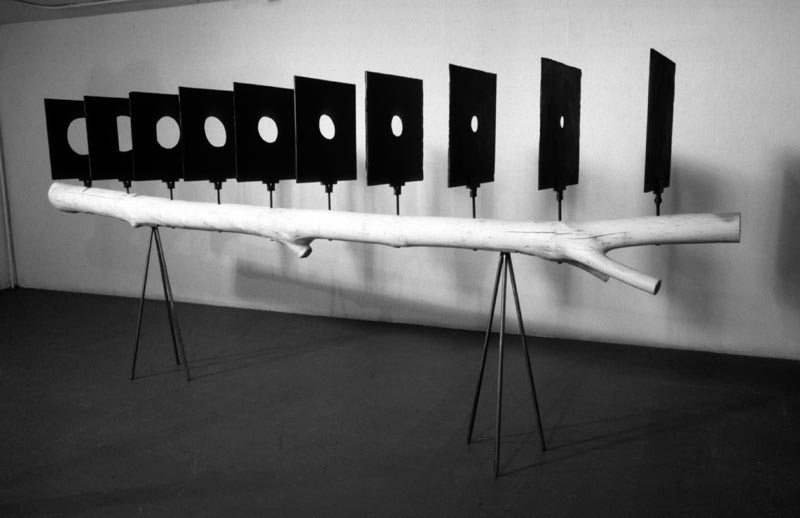
Time and Space __ 1995
Steel, wood and slate. 72 x 168 x 20 inches
. . . . .
Time and space once were considered separate concepts. Einstein’s special theory of relativity led to the realization that time and space could be described as a whole and broadened our interpretation of the two ideas. When Einstein wanted to understand what a light wave might look like, he imagined himself traveling along side it at the speed of light. In order to understand a problem, sometimes it is necessary to step aside it to gain a new perspective.

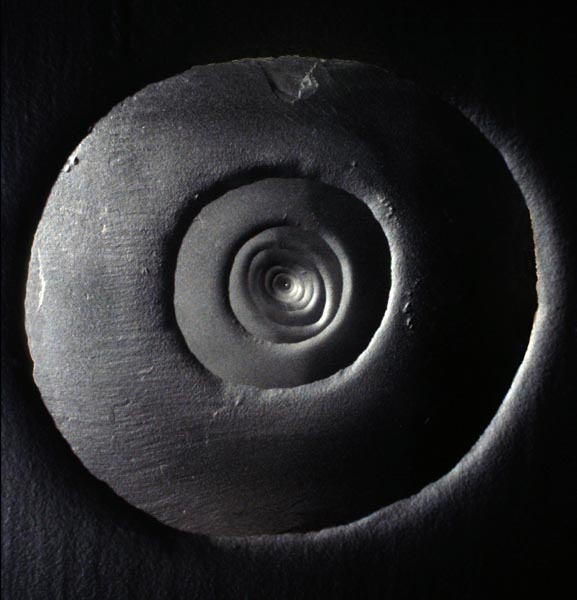
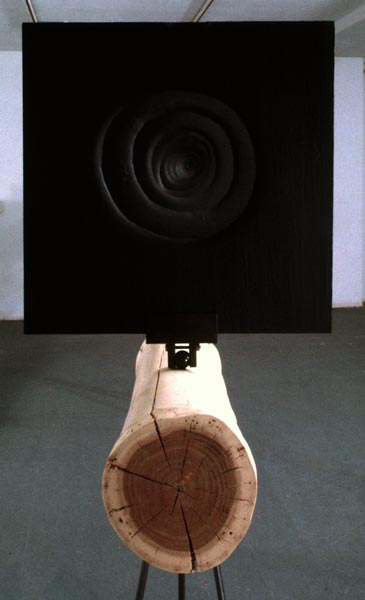
With the piece "Time and Space," I was concerned with how people think, or specifically how they solve a problem. I wanted to create a form that visually and physically dealt with looking at something from a different perspective. When looking through the holes, one view is very narrow where only the edges can be perceived. The other begins with a generalized point of view that narrows with the passing of time. It is from this perspective that I began to understand what I could learn from this work.

As I look down the tapering form, the relationship between the empty space and the rings of the branch reveals itself. Both are conical forms that express a sense of time. The negative space of the slate exists in the present as I focus down the chamber of holes and the view of the branch rings are a historical record of the past life of the branch. I used to count the rings of a tree from a two dimensional perspective starting in the middle and counting my way outward. The rings have now become cones in which I see the presence of both time and space.