index next
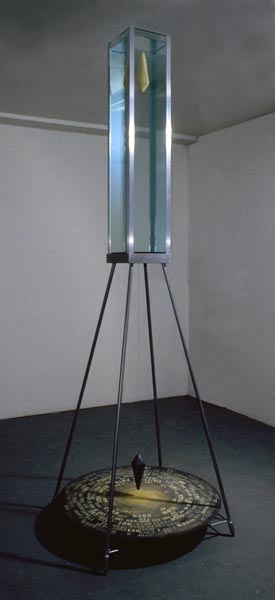
The Indian Puzzle __ 1994
Steel, glass, water, wax, aluminum, slate & lead. 101 x 35 x 35 inches
. . . .
In the 19th century, the British government set out to survey its newly acquired colony of India. In the process of surveying, they came across a curious discrepancy between two towns. The first town was Kaliana, which is sixty miles south of the Himalayan Mountain range and Kalianpur which is 375 miles farther south. The results of their measurements were off by an unacceptable amount of 500 feet.

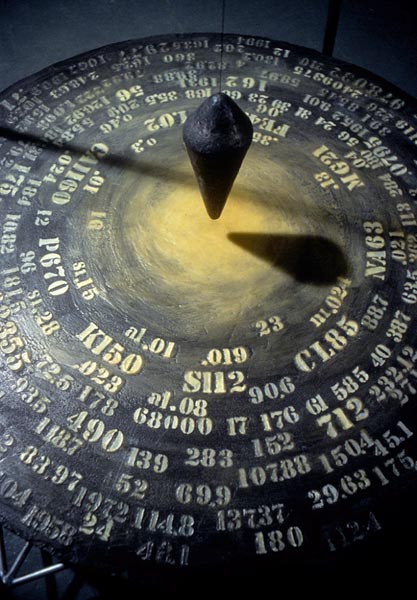
Part of the problem occurred with the precise astronomical method of measuring the angles of the stars. This method relies on a simple measuring tool called a plumb bob, which is basically a weight hung by a string. The plumb bob, when suspended from the string, was believed to accurately give a line perpendicular to the Earth's surface. But, because of variations in the measurements between the two towns, it has been hypothesized that the plumb bob was attracted toward the large gravitational mass of the Himalayas, thus deflecting the plumb line out of perpendicular.

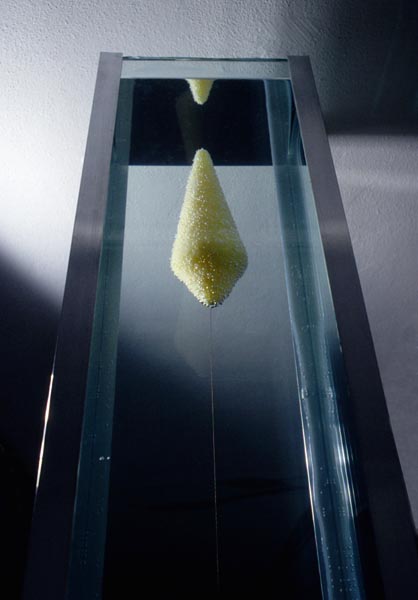
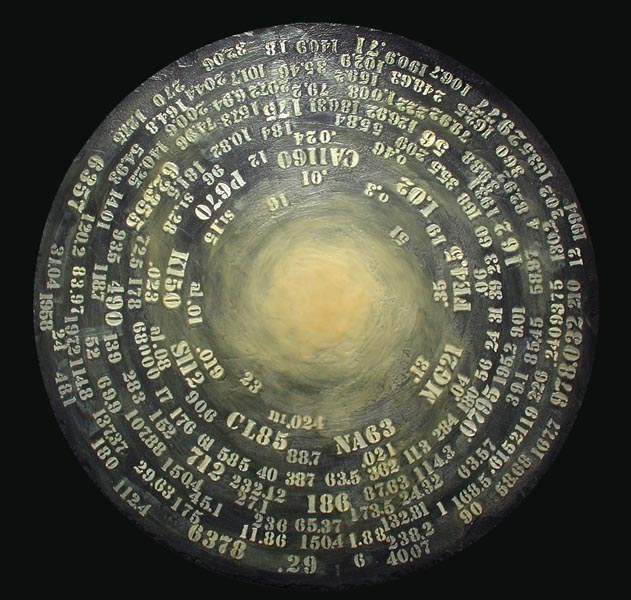
"The Indian Puzzle" as I interpret it, concerns itself with the fluidity of knowledge. What we believe to be factual knowledge is actually constantly changing and evolving into a new standard of beliefs. Factual information is relative to what we believe to be true at the time. The piece is divided into two realms - that of the empirical and the ephemeral. One is held down and restrained by the force of gravity; the other is upheld by it. At the base of the piece is a puzzle comprised of various types of specific measurements.